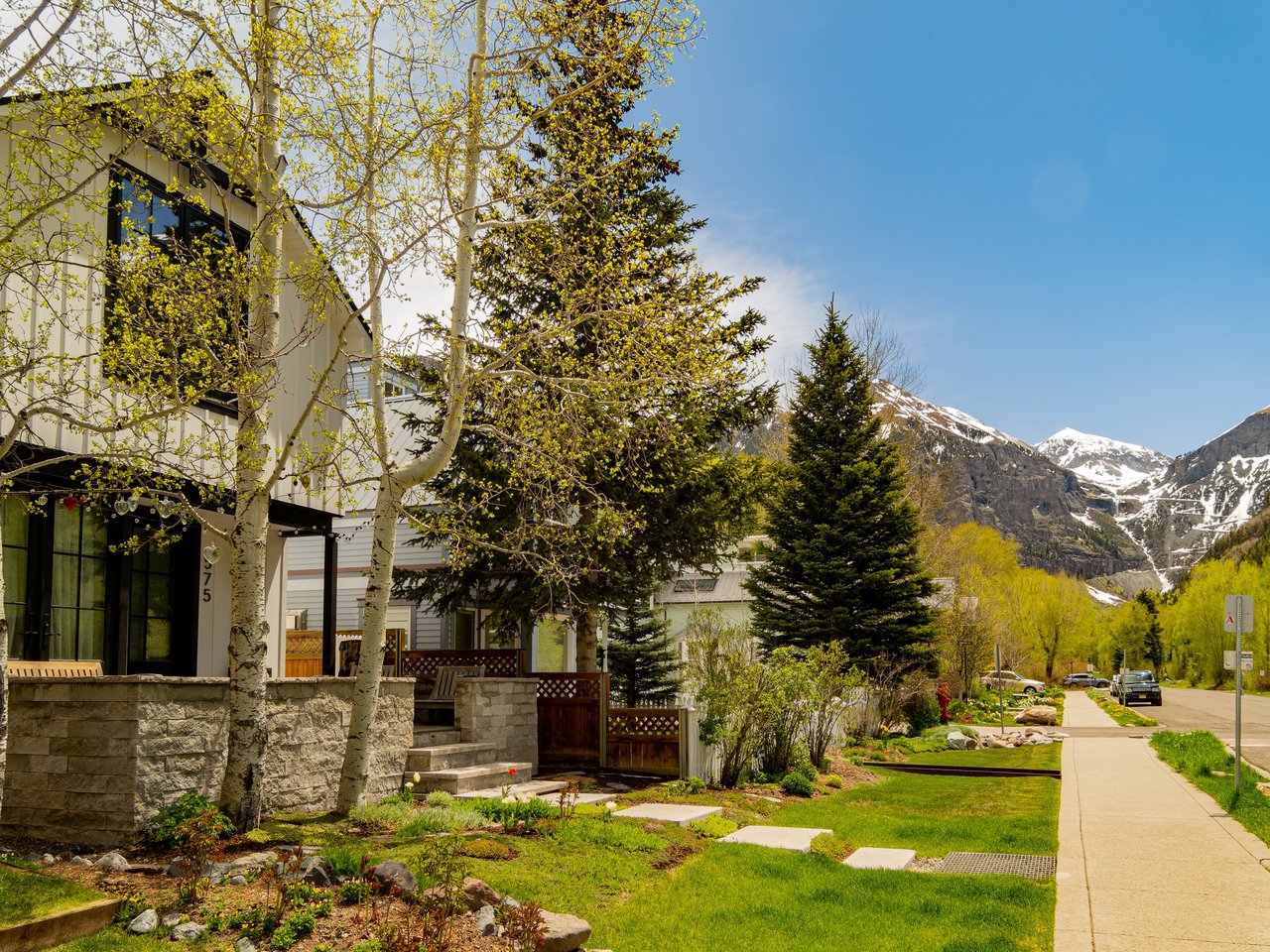
Telluride sits at the intersection of rarity and long-term potential. It’s a mountain enclave with a fixed footprint, a global luxury audience, and a development timeline that still has room to grow. Investors who understand the value of scarcity—and the power of thoughtful planning—recognize what’s happening here. Telluride is entering the phase that Aspen, Vail, and Jackson Hole experienced a decade or more ago. And it’s doing so with stronger guardrails, deeper preservation, and even tighter constraints on growth.
The region’s boundaries aren’t theoretical—they’re physical. National forest land, conservation easements, steep terrain, and decades-old PUDs create a natural limit on how much can be built and where. This structure funnels the entire buying pool directly into Telluride and Mountain Village, with only a handful of adjacent sub-markets offering additional opportunity.
That reality preserves what people love most: a true mountain town that feels intimate, protected, and impossible to duplicate.
The entire region operates under long-established master plans. Density caps were set decades ago and have only tightened since, creating an unusually controlled environment for a resort market. Every major area—Telluride, Mountain Village, and surrounding ranch communities—was carefully planned rather than driven by opportunistic expansion.
For investors, that predictability matters. It keeps the market disciplined, the experience refined, and the long-term value story remarkably steady.
Telluride didn’t just inherit low density—it actively protected it. Several of the most significant moves came from major down-zonings that reshaped the region’s future:
Aldasoro Ranch
A 1,500-acre ranch originally zoned for 2,500 units was reduced to 150 single-family homes on three-acre sites in 1981.
West Meadows
A 1,200-acre ranch at the entrance to Mountain Village went from 2,500 units to just 31 single-family lots, each 35 acres. Vacant lots now trade above $6M—and none are available.
The Valley Floor
In 2002, the Town of Telluride purchased 586 acres for $50M, permanently protecting the scenic three-mile entry corridor and eliminating the last major opportunity for expansion. That acquisition effectively land-locked Telluride from future outward growth.
At this point, every other large parcel in the region has been master-planned or built out. There is no remaining land for future large-scale development.
While storied ski destinations like Aspen and Sun Valley took shape in the mid-20th century, Telluride’s modern chapter didn’t begin until the 1970s. The resort’s pivotal growth—the lift expansions, the golf course, and the early infrastructure—took shape through the 1990s.
This later timeline allowed Telluride to grow more thoughtfully, avoid overdevelopment, and preserve the open space and quiet sophistication that now define it. Investors benefit from a market that feels mature but is still early in its long-term arc.
Demand in recent years hasn’t just increased—it has consistently outpaced supply. Historic absorption rates, rapid appreciation, and record-breaking price points across nearly every segment signal a highly competitive landscape.
A recent example: The Highline, one of Mountain Village’s new condo developments, is already 56% contracted (9 of 16 units) at record prices per square foot, having just broken ground. It’s a natural outcome of a market where buyers act quickly, and every new opportunity is met with immediate interest.
Only four multi-unit projects remain in the Mountain Village Core—and all are fully entitled:
Four Seasons Telluride
Six Senses Telluride
The Highline
Belvedere III
These will be the last of their kind. Once built, Mountain Village will have no further opportunities for multi-unit development. That finality reinforces long-term value across the entire region.
Telluride’s geography tells the story plainly. It sits in a box canyon surrounded by steep peaks, public land, and protected open space. There’s no room for outward expansion and no future subdivisions waiting in the wings. The town’s natural boundaries act as a protective moat, ensuring that what exists today remains rare—and stays rare.
Some advantages are structural. Others are emotional—but no less powerful.
The setting is unmatched: dramatic peaks surrounding a historic townscape.
The gondola is the only one of its kind in North America—connecting town and mountain with a view that feels cinematic every time.
Historic designation preserves the character that people fall in love with.
Telluride Ski Resort consistently ranks among the top resorts in North America, recognized by USA Today, Forbes, OnTheSnow, Ski Magazine, and Peak Rankings.
It’s hard to find a more visually striking or more carefully preserved mountain environment.
Telluride offers a combination you rarely see: a protected footprint, a global luxury audience, a final chapter of new development, and a landscape that cannot expand. This is a market built on intention and shaped by scarcity—two qualities that consistently drive long-term appreciation in the world’s most sought-after destinations.
Let’s discuss your goals, timeline, and the numbers that will move you forward. Reach out and let’s talk about your goals — I’m committed to earning your trust.